

Malligai Top Notes
How Madurai jasmine is powering French luxury perfume
By Amruta Prabhu
Hidden inside the iconic French perfumes J’adore by Dior and Mon Guerlain is Jasmine sambac, or Madurai jasmine as it is also known. These luxury perfumes may be French, but this special ingredient can be traced back to the ancient markets and traditions of Madurai, Tamil Nadu.
Nestled in the fertile plains of the Vaigai river, Madurai is one of the oldest cities in India, with recorded history going back to the 3rd century BC. Known to the ancient Greeks and Romans, the city is often referred to as the “Athens of the East” due to its rich architectural and literary heritage. At its heart stands the iconic Meenakshi Temple, a masterpiece of Dravidian architecture dating back to the 14th century.

The city’s people are deeply devoted to Tamil culture and to the fish-eyed goddess Meenakshi, who has been the guardian of the city for more than two thousand years. Madurai jasmine is deeply entwined with the history and culture of the city. Legend has it that it is Meenakshi’s love for her consort, the Lord Shiva, that gives Madurai jasmine its intoxicating aroma. This jasmine variety has been attested to in classical Sangam literature since the 3rd century BC.
The fame of Madurai jasmine reached further afield too. For many years, French manufacturers had been using another variety, jasmine grandiflorum, in their perfumes. The plant, which is native to Asia, found its way to Europe through Persia, from where it takes its name (Yasmine). Perfumers in the fortified hill town of Grasse pioneered the European cultivation of jasmine grandiflorum as far back as the 17th Century. At its peak in 1930, about 800 hectares of area in Grasse were dedicated to the cultivation of jasmine grandiflorum. With rising labour, land and production costs, this figure dropped drastically to only 42 hectares by the 1980s.
That’s when French perfumers discovered that India not only grew jasmine grandiflorum in abundance but also had another, even more delicate, treasure to offer. Europe is too cold to grow Madurai jasmine, but the hot climate and rich red laterite soil of Madurai provide the perfect conditions for this flowering plant to produce a milky-white bloom whose fragrance is even more bold and heady, pure and delicate, than the hardier jasmine grandiflorum.
In 1989, Jean-Paul Guerlain, master perfumer at the 200-year-old luxury firm, used Madurai jasmine to create a perfume called Samsara. Almost overnight, Madurai jasmine became a must-have ingredient for top perfume houses. Launched in 1999, Dior’s legendary J’adore perfume, with its gold Greek amphora bottle, was another runaway hit. Through the 2000s, enigmatic French perfumer Serge Lutens also used the white flower in a variety of his creations such as A la Nuit, described as “all jasmine…a nocturnal scent pervading the warm air.”
But these masterpieces of the French perfumer’s art – and the huge profits they bring – are only made possible by hard labour in the villages around Madurai. Some 100,000 farmers depend on jasmine cultivation to earn their living. They wake up at three in the morning to harvest this night-blooming flower. The intoxicating “queen of the night” must be plucked before the bud has blossomed, because once the flower opens, it rapidly loses its fragrance. To ensure that the buds get to the market by 8 am, when their aroma is at its peak, harvesters head into their fields with torchlights on their head, picking out each bud by hand. With their delicate fingers and keen eyes, women are especially skilled at this manual task. They drop the plucked buds into their sari fabric, creating a kind of pocket that keeps the tender flowers cool, preventing them from wilting in the sun.
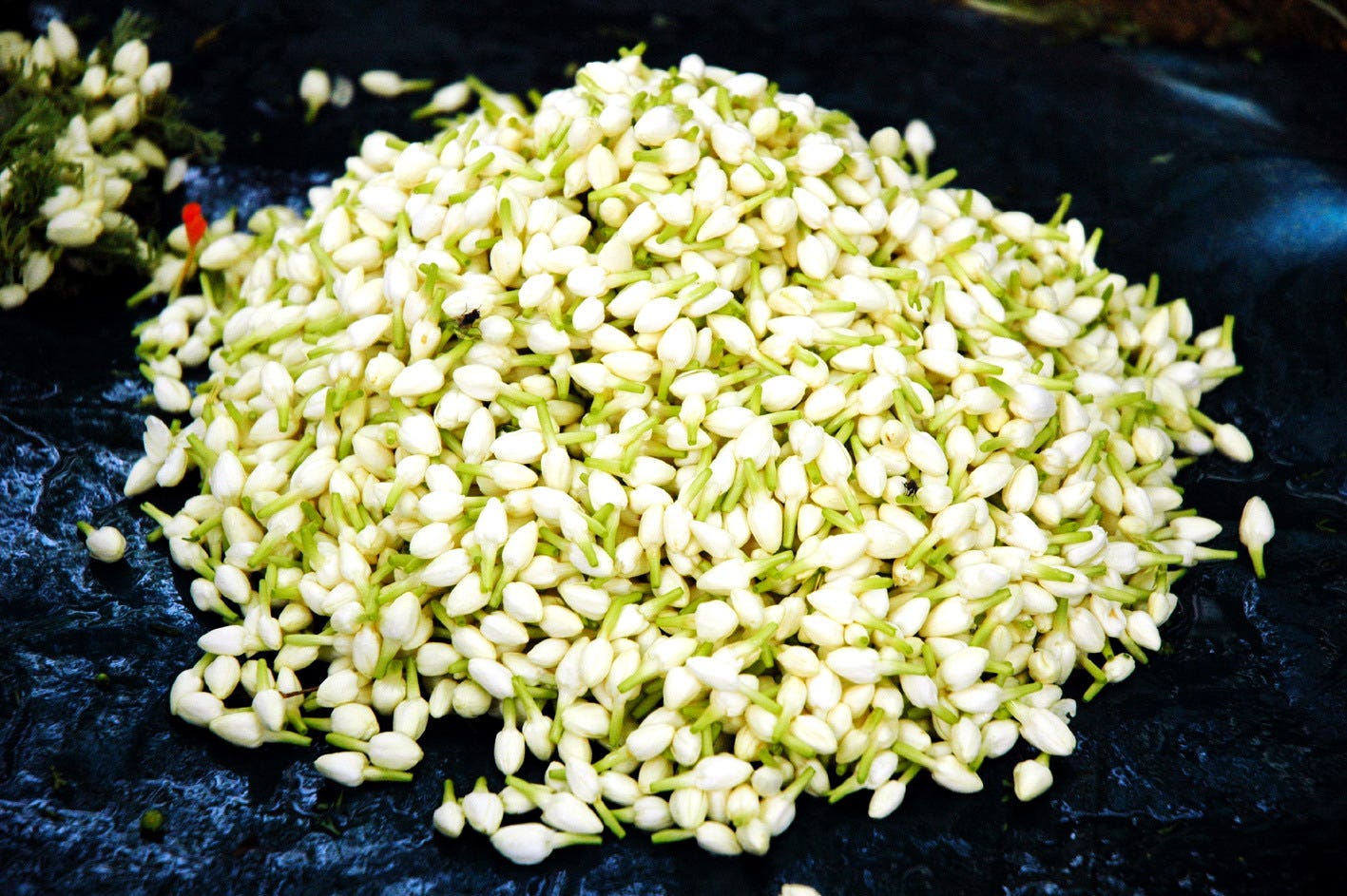
From the market, tonnes of jasmine buds are brought in jute bags to the factory yards every evening, where they are spread out with a rake or with workers’ feet to prevent heat build-up. As soon as the flowers begin to emit their fragrance, they are loaded into an extractor, which traps the aromatic molecules into a thick waxy paste called “concrete.” This hard substance is then washed with alcohol to produce the liquid gold called jasmine absolute, a highly concentrated version of the jasmine scent, which can be stored for decades.
It takes around 1300 hours of labour to gather one tonne of jasmine, which in turn produces a kilo of absolute. A bottle of perfume requires as little as one or two grammes of this precious extract. However, the markups on the final product are huge. In the final price of a high-end perfume, often between 150 and 200 euros per bottle, it can be estimated that only around 2 euros go toward paying the farmers in Madurai.
The relationship between local producers and luxury perfume houses has had some surprising impacts on the local ecosystem. The high sustainability norms required by Europe means that producers have begun working with farmers to implement natural farming measures. Implementing these practices is slow, challenging and requires a lot of investment, which brands like Louis Vuitton, Dior and Guerlain have been willing to make. “Customers and investors globally are asking companies like LVMH questions on traceability and sustainability of their products. There is the realization that if we don’t do things right today, there may not be a tomorrow,” Raja Palaniswami, Director of Jasmine Concrete Exports explains, in an interview to The Plate.
Thierry Wasser, who has been the “nose” of Guerlain since 2008, and the famous name behind perfumes like Dior’s Addict and Guerlain’s L’Homme Idéal, now makes an annual visit to the region. Speaking to AFP, he gushed: “To me this flower is the expression of love. It is lush, it is rich, it is vibrant, it has a smoothness…and something floral which is immutable.”
Unfortunately, while the global customers of France’s luxury powerhouses may share Wasser’s appreciation for Madurai jasmine’s scent, few, if any, know of its long South Asian heritage. The mystique of French perfume is still resolutely French, and the opportunity to tell Madurai’s story and build value on Indian culture remains untapped. Recognizing the “deep fragrance” of the jasmine sambac, India only gave it a geographical indication (GI) tag in 2013. Could an Indian luxury house elevate Madurai jasmine to achieve premium value on a global stage? Only time will tell.